


How to Stop Impulse Spending Using Anime Discipline Techniques reveals how anime-inspired habits like training arcs, binding vows, and mindful strategies can help you control emotional spending, build discipline, and achieve long-term financial freedom without stress.
Have you ever stood in a checkout line, a shiny new gadget or a completely unnecessary but adorable plushie in your hand, feeling that familiar, intoxicating pull?
Your heart beats a little faster, your brain offers a flurry of justifications (“I’ve had a hard week!” “It’s on sale!”), And before you know it—beep—the purchase is made.

Later, the guilt creeps in, alongside the dread of a dwindling bank account. If this sounds like you, you’re not fighting a simple bad habit. You’re in a battle against a primal urge, and you need a hero’s discipline to win.
What if I told you the secret to financial control isn’t in a dry budgeting spreadsheet, but in the world of anime?
The same medium that brings us epic battles, heart-wrenching stories, and characters with gravity-defying hair also holds profound lessons in mastery, focus, and willpower.
By channeling the discipline of your favorite anime protagonists, you can transform your finances. Let’s embark on a training arc for your wallet.
The Real Enemy: Emotional Spending (Not Lack of Willpower)
Impulse spending is the modern villain—fast, sneaky, and emotionally persuasive. One moment you’re calm, the next you’re buying something you didn’t plan for, didn’t need, and might even regret. If this sounds familiar, you’re not broken. You’re human.

Impulse spending isn’t a math problem. It’s an emotional reflex.
You don’t overspend because you’re bad with money. You overspend because:
- You’re stressed.
- You’re bored.
- You want comfort or validation.
- You feel like you “deserve it.”
Anime understands this perfectly. Every great story shows that the strongest battles are internal.
In Naruto, Naruto doesn’t become strong overnight. He struggles with loneliness, rejection, and anger—but learns discipline before power.
Your money journey works the same way.
The Shonen Jumpstart: Recognizing Your “Big Three” Financial Enemies
Every great shonen hero starts by understanding their adversary. In the world of impulse spending, you face three main villains:

- The Temptation Demon (Your Brain on Dopamine): This is the instant-gratification monster. That rush you feel when you click “buy now”? That’s dopamine, the same chemical reward that drives Tanjiro Kamado (Demon Slayer) to keep fighting, or Naruto to crave ramen. The problem is, it’s a short-lived high that leaves a void, demanding another purchase to fill it.
- The Background Stress Spirit: Like the cursed energy in Jujutsu Kaisen, everyday stress and emotional fatigue linger. Impulse spending often becomes an exorcism ritual—a quick, easy way to dispel feelings of boredom, sadness, or anxiety. It’s a Hollow masquerading as a solution.
- The Illusion of Scarcity Genjutsu: “Limited time offer!” “Only 3 left in stock!” This is a classic genjutsu—an illusion cast by marketers to cloud your judgment. It creates a false sense of urgency, making you fear missing out (FOMO) more than you fear financial instability.
To defeat them, you need to assemble your own squad of techniques, borrowed from the masters of anime discipline.
Technique 1: The “Rock Lee’s Weights” Budgeting Method
Remember Rock Lee from Naruto? While others used ninjutsu, he achieved legendary strength through sheer, grueling physical discipline. His signature move?

Training with incredibly heavy weights on his limbs, which he removed only in dire need, making him faster and stronger than anyone anticipated.
Your Application: The Discretionary Weight Lock.
Most budgets fail because they feel like deprivation. The Rock Lee method flips the script.
- Identify Your Discretionary Spending: This is your “fun money”—coffee, snacks, games, non-essential clothes.
- Apply the Weights: Instead of having instant access to this money via your debit card or digital wallets, create deliberate friction. Withdraw this amount in cash at the start of the week or month. This physical stack of bills is your weighted wallet.
- Carry the Weight: Use only this cash for impulse purchases. Seeing the money physically leave your hands is a powerful, tangible reminder of the cost that a card swipe can never match. When the cash is gone, your training for that period is complete. You cannot remove the weights (dip into other funds).
- The “Remove the Weights” Moment: Just like Lee, you’ll have a designated moment to shed this restriction—this is your planned, guilt-free, larger purchase saved for over months. The contrast will make it feel incredibly rewarding.
Technique 2: The “One Piece” Long-Term Treasure Map
Luffy’s dream in One Piece isn’t vague. It’s singular, vivid, and unwavering: to find the legendary treasure and become the Pirate King. Every decision, every battle, is in service to that ultimate, distant goal.

Your Application: Define Your Financial “One Piece.”
Your vague desire to “save money” is too weak to combat a potent dopamine hit. You need a treasure map.
- Draw Your Map: What is your ultimate financial treasure? Is it a down payment for a home (your Going Merry)? A life-changing trip to Japan (your Grand Line adventure)? Achieving financial independence to pursue your passion (becoming the Pirate King of your life)?
- Make it Visual: Create a vision board. A savings tracker that looks like a map, filling in. Set your phone background to an image of your goal. Luffy doesn’t forget his dream, and neither should you.
- Ask the Key Question: When temptation strikes, hold the item and ask: “Does this bring me closer to my One Piece, or is it steering me off course?” A new game might be a temporary island, but does it delay the journey to your final treasure? This simple question aligns your micro-actions with your macro-dream.
Technique 3: The “Hunter Exam” Waiting Period
The Hunter Exam in Hunter x Hunter is a grueling test of patience, strategy, and endurance. Candidates must often wait, analyze, and resist acting on impulse to succeed.

Your Application: The 24-Hour (or 72-Hour) Rule.
Implement your own personal Hunter Exam for every non-essential purchase.
- See a coveted item? Add it to your cart or take a picture of it. Then, walk away.
- Set a Timer: For items under $50, impose a 24-hour waiting period. For items over $100, make it 72 hours. This is your cooling-off exam phase.
- During the Exam: Analyze the item like a Hunter analyzes their prey. Do research. Sleep on it. Most of the magic of the “must-have” item will fade. The urgent dopamine scream will quiet, allowing your logical brain, the voice of Killua’s strategy, to be heard. If you’ve genuinely forgotten about it after the period, it was pure impulse. If the desire remains, you can then apply your other techniques to evaluate it strategically.
Technique 4: The “Jujutsu Binding Vow” – A Pact With Yourself
In Jujutsu Kaisen, a Binding Vow is a sacred, magical contract that restricts a user in one way to gain immense power in another. It’s a self-imposed limitation for a greater reward.

Your Application: The No-Spend / Low-Spend Challenge Vow.
Create a personal Binding Vow with clear rules and a clear reward.
- The Restriction: “I vow not spend any money on dining out for the next 30 days.” Or “I vow to only buy essential groceries, with no ‘fun’ additions, for two weeks.”
- The Enhanced Power: The money saved MUST be physically or visibly moved to a high-yield savings account or a dedicated investment for your “One Piece.” Watching that specific pot grow is your enhanced power.
- The Stakes: The cosmic stake is your own self-trust. Breaking a Binding Vow has consequences in Jujutsu society; here, it weakens your financial resolve. Succeeding, however, massively levels up your discipline stat.
Technique 5: Channel Your Inner “Attack on Titan” Scout: Know Your Territory
The Scout Regiment in Attack on Titan ventures beyond the walls to map the unknown, understand Titan behavior, and identify threats. They don’t survive on brute force alone, but on meticulous intelligence.
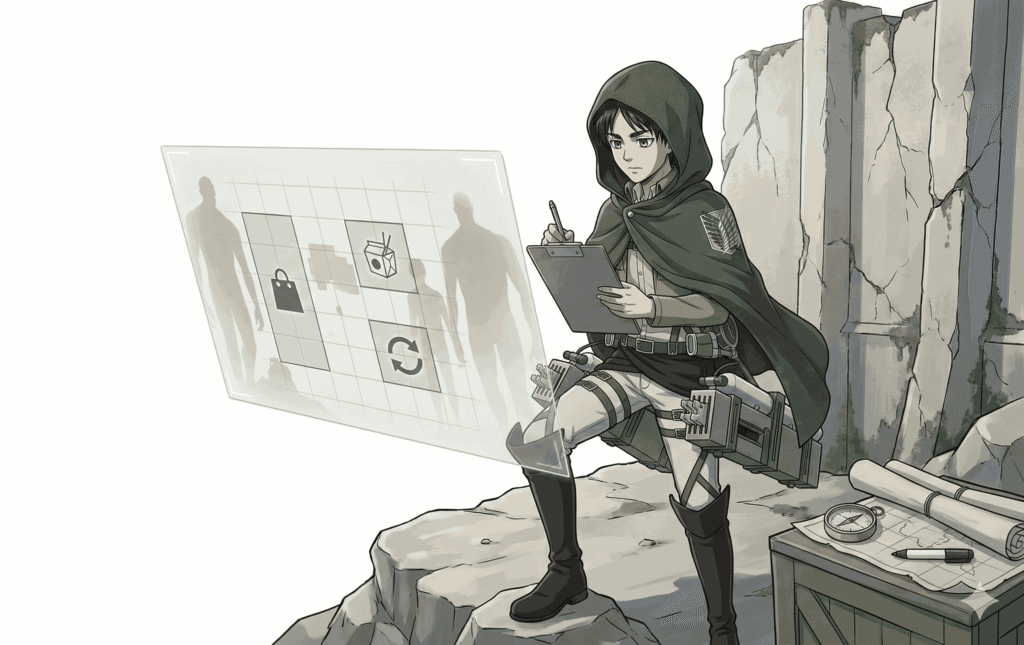
Your Application: Track and Analyze Your Spending.
You must know where your money is going, just as the Scouts must know the landscape.
- Use an App or Simple Spreadsheet: For one month, track every single expense. No judgment, just reconnaissance. This is your map beyond the wall.
- Categorize Your Titans: Label your spending—”Entertainment Titan,” “Food Titan,” “Subscription Titan.”
- Identify Your Weak Walls: Where are the breaches? Is it late-night Amazon scrolling? Is it the coffee shop on the corner? Knowing your personal “Titan” patterns allows you to fortify your defenses. You can’t stop an impulse you don’t see coming.
Technique 6: The “Fullmetal Alchemist” Principle of Equivalent Exchange
The core law of alchemy in Fullmetal Alchemist is unwavering: to obtain something, something of equal value must be lost. You cannot create something from nothing.

Your Application: The Financial Transmutation Circle.
Before any non-essential purchase, you must perform a mental alchemy.
- Define the Gain: What is the item? What value does it truly bring? Joy? Convenience? Status?
- Calculate the Cost (The True Loss): It’s not just the dollar amount. It’s the hours of your life you traded to earn that money. It’s the progress toward your “One Piece” that is sacrificed. Is this item truly of equivalent value to the life energy and future freedom you are exchanging for it?
- Perform the Transmutation: If the exchange isn’t equal, the transaction fails (you don’t buy it). This forces profound mindfulness, transforming spending from a trivial act into a conscious choice about the value of your time and future.
The Final Boss Battle: Forging Your Own Hero’s Resolve
Anime discipline isn’t about perfection. Even the greatest heroes stumble. Midoriya Izuku breaks his bones, Gon loses his way, and Goku constantly oversleeps. The point is their unwavering commitment to get back up and continue their training.
You will have setbacks. A stressful day will lead to an unplanned purchase. That’s okay. Don’t succumb to the “well, I already failed, might as well give up” spiral. This is just a filler episode in your financial anime.

Treat your financial journey as your own character development arc. Each saved dollar is a training rep. Each resisted impulse is a battle won. Each step toward your big goal is a power-up.
Start small. This week, implement the 24-Hour Hunter Exam Rule. Next month, try a 7-Day Low-Spend Binding Vow. Draw your Treasure Map. Forge your discipline in the small, daily choices.
Remember, the most powerful force in any anime is not the flashiest attack, but the unbreakable will of the protagonist.
Your financial freedom is your ultimate transformation sequence. Now, go beyond your limits—PLUS ULTRA!—and take control of your spending, one conscious, hero-worthy decision at a time. Your future self, enjoying the bounty of your discipline, will be the greatest hero of all.
Other Interesting Posts To Read:
Daily Money Habits That Turn You Into a Financial Superhero (Anime Edition)
Create Your Financial Anime Arc: Planning Money Milestones Like a Series
Power-Up Your Wealth Tree: Growth Investing with Anime Tropes
Upgrade Your Money Mana: Skills Every Anime Fan Should Know for Smart Spending
Financial Villains to Watch: Anime-Style Analogy for Hidden Money Traps

[…] How to Stop Impulse Spending Using Anime Discipline Techniques […]